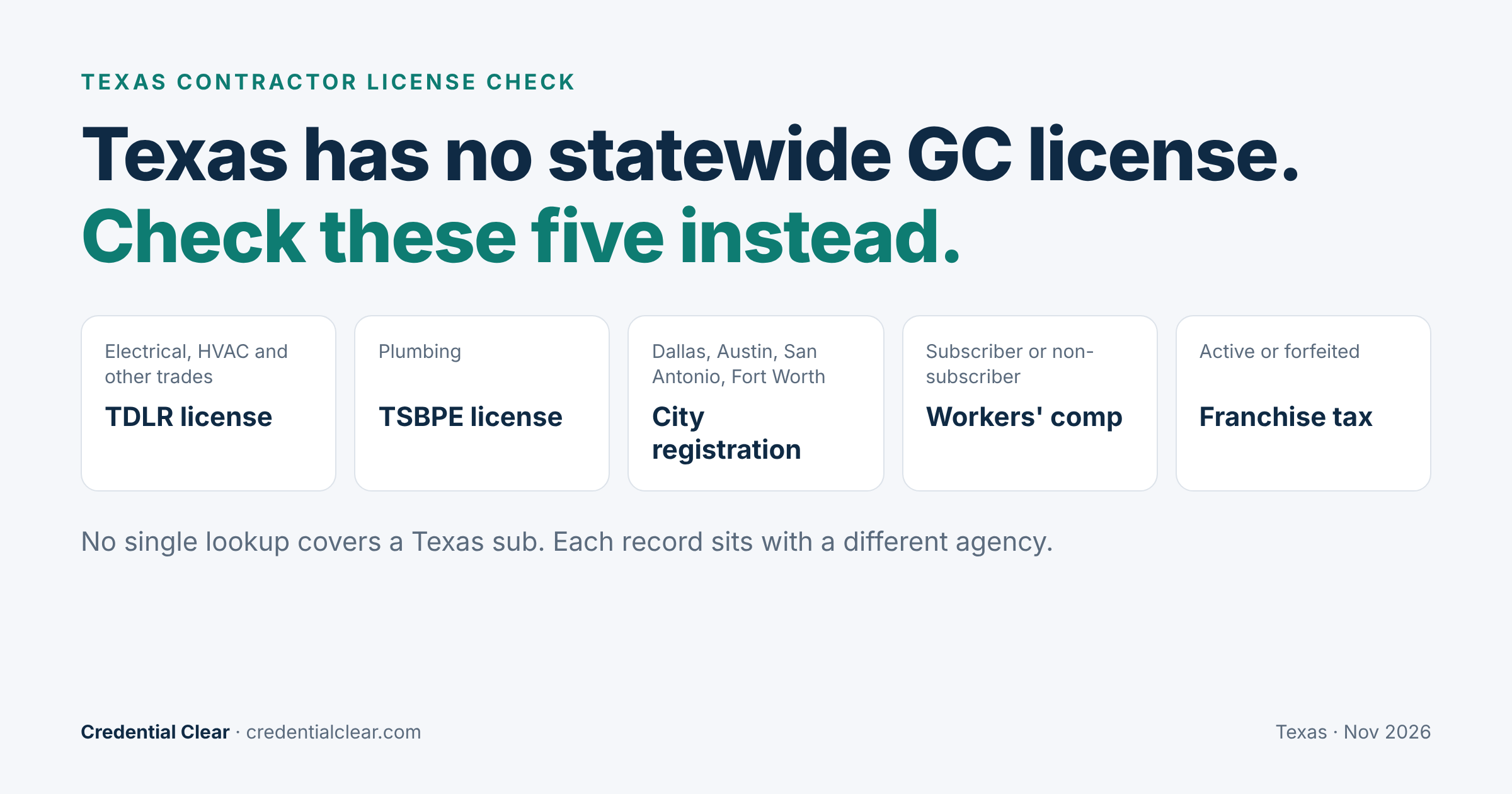
Short answer: Texas does not issue a statewide license to general contractors. To vet a Texas contractor, check the trade licenses the state does issue (electrical and HVAC through TDLR, plumbing through the State Board of Plumbing Examiners), the city registration where the work is, workers' comp status, and franchise-tax standing. Then re-check on a schedule, because each of these can change after you hire.
This article is general information, not legal advice.
Why "license lookup" works differently in Texas
In most states, one search on the state board tells you whether a GC is licensed. In Texas there is no such board for general contractors. A GC can be fully legitimate with no state license number at all.
That shifts the work to you. Instead of one record, you are checking four or five, held by different agencies, each updated on its own timeline.
What to check on a Texas contractor
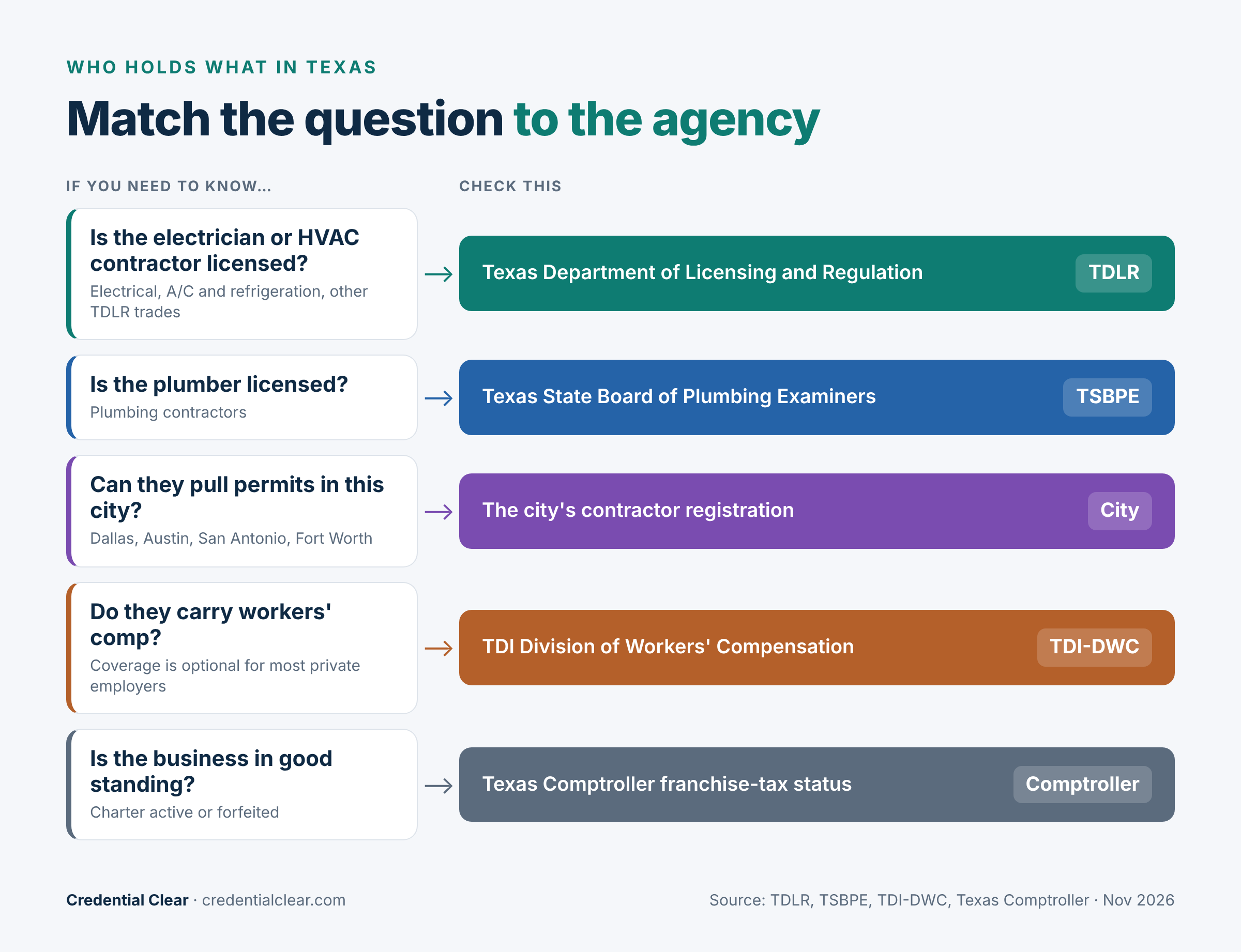
| Check | Who holds it | What it tells you |
|---|---|---|
| Trade license (electrical, A/C and refrigeration, and other TDLR trades) | Texas Department of Licensing and Regulation (TDLR) | Whether the electrician or HVAC contractor on your job holds a current license |
| Plumbing license | Texas State Board of Plumbing Examiners (TSBPE) | Whether the plumbing contractor is licensed |
| City contractor registration | Cities such as Dallas, Austin, San Antonio and Fort Worth | Whether the contractor can pull permits in that city |
| Workers' comp status | Texas Department of Insurance, Division of Workers' Compensation | Whether the business is a subscriber or a non-subscriber |
| Franchise-tax status | Texas Comptroller | Whether the entity is active or forfeited |
Workers' comp is optional in Texas, and that matters to you
Texas lets most private employers choose not to carry workers' compensation coverage (Tex. Lab. Code § 406.002). A non-subscriber sub is legal. It also means an injured worker on your job may look for another party to pay, and the GC or property owner is the obvious one.
Know which kind of sub you are hiring before work starts, and get the certificate of insurance either way.
The check is only good the day you run it
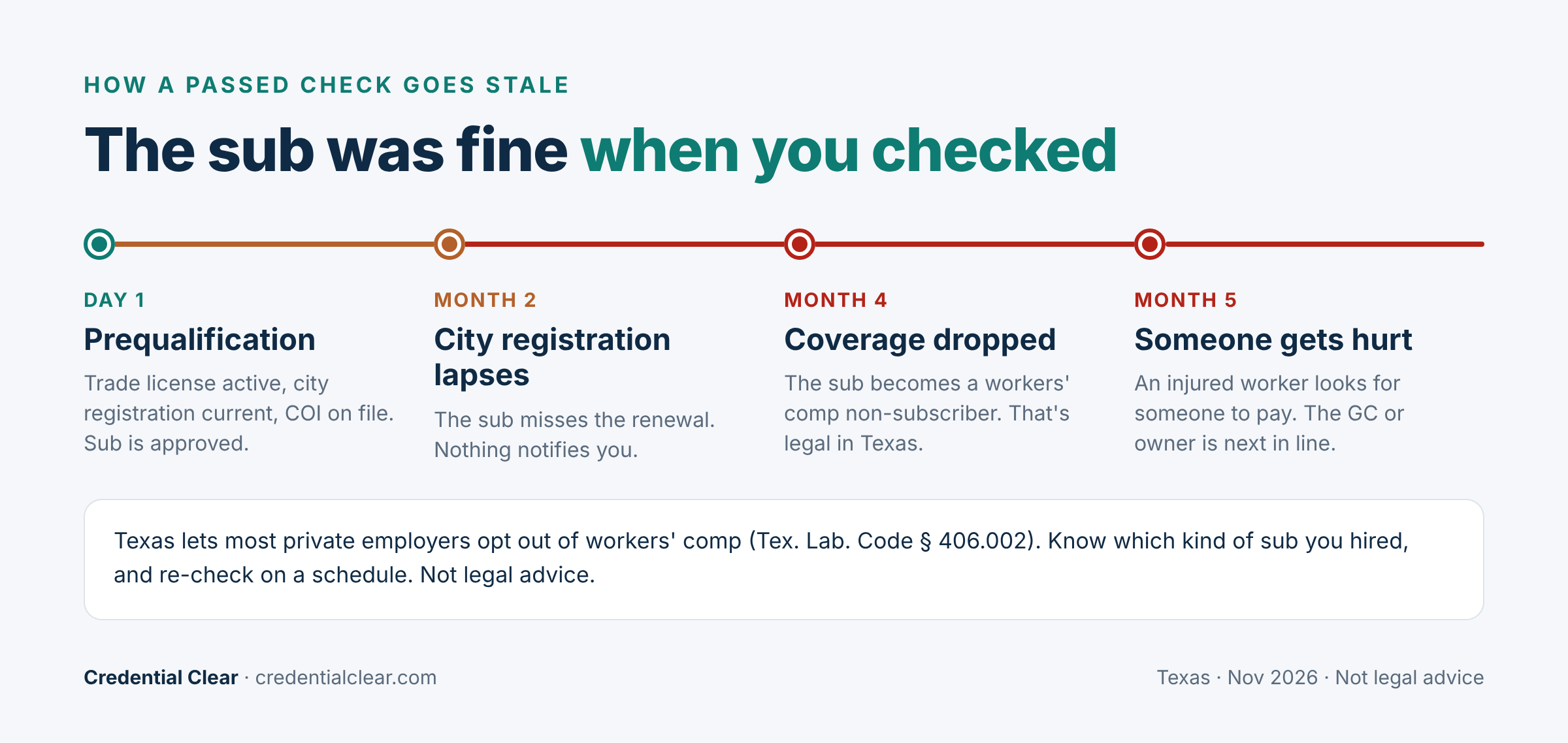
Prequalification captures one moment. After that, a TDLR license can expire, a city registration can lapse, an entity can forfeit its charter, or a sub can drop coverage. None of those agencies will call you.
The common fix is a spreadsheet and a calendar reminder. It works until the roster passes 30 or 40 subs, or the person who owns it leaves.
How CredentialClear handles Texas
CredentialClear searches TDLR, the Dallas, San Antonio and Fort Worth contractor registries, Texas workers' comp subscriber and non-subscriber records, Comptroller franchise-tax status and structural pest control licenses in one search. Add the contractor to your roster and it is re-checked on a schedule. You get an email when a tracked license's status changes. For insurance and bonds, send the sub a COI request link and CredentialClear reads the certificate for you.
Start your free trial (15 days, no credit card to start) or see the Texas page.
FAQ
Does Texas require a general contractor license? No. Texas has no statewide general contractor license. Some trades are licensed by the state, and many cities require contractors to register.
How do I check a contractor's license in Texas? Identify the trade, then check TDLR (electrical, HVAC and other trades) or TSBPE (plumbing). For a GC, check the city registration where the job is, plus workers' comp and franchise-tax status.
Is workers' comp required for Texas contractors? For most private employers, no. Texas allows non-subscribers (Tex. Lab. Code § 406.002). Ask for proof of coverage or a non-subscriber plan and confirm it on the state's records.
How often should I re-check a Texas sub? At minimum before each new job and at renewal dates. Continuous monitoring re-checks on a schedule so you hear when something changes.
Not legal advice. Talk to your attorney about your contracts and insurance requirements.