How do you verify a contractor's license?
Short answer: Get the contractor's license number and legal business name. Find the licensing board for their trade in the state where the work is, and search the board's online lookup. Then check five things: the status is active, the classification covers the job, the name and qualifier match, the license won't expire mid-project, and there's no open discipline. Repeat for every state the contractor works in.
Most people stop at the word "Active." That's the first check, not the whole check. A contractor can hold an active license that's the wrong type for your job, too small for its value, or about to lapse. And in some states, the general contractor license you're looking for doesn't exist at all.
This guide walks through the process once, so it works in multiple states. It covers what to collect first, the five checks, where to look in the 18 states we cover, and what each status means. For a state with an unusual setup, see our guide to North Carolina's contractor licensing boards.
What you need before you start
Collect four things from the contractor before you search. Asking for them is normal, and a contractor who can't produce them quickly is telling you something.
| What to ask for | Why it matters |
|---|---|
| License number | The fastest, most exact search. Names are often similar or out of date. |
| Legal business name (and any DBA) | The license is issued to the legal entity, which may not match the name on the truck. |
| States where they'll work | Licenses are state by state. A license in one state means nothing in the next. |
| Trade and scope of the job | Tells you which board to search and which classification to expect. |
If the contractor will bring in subcontractors for electrical, plumbing or HVAC work, ask for the subs' license numbers too. Their licenses usually sit with different boards.
The five checks
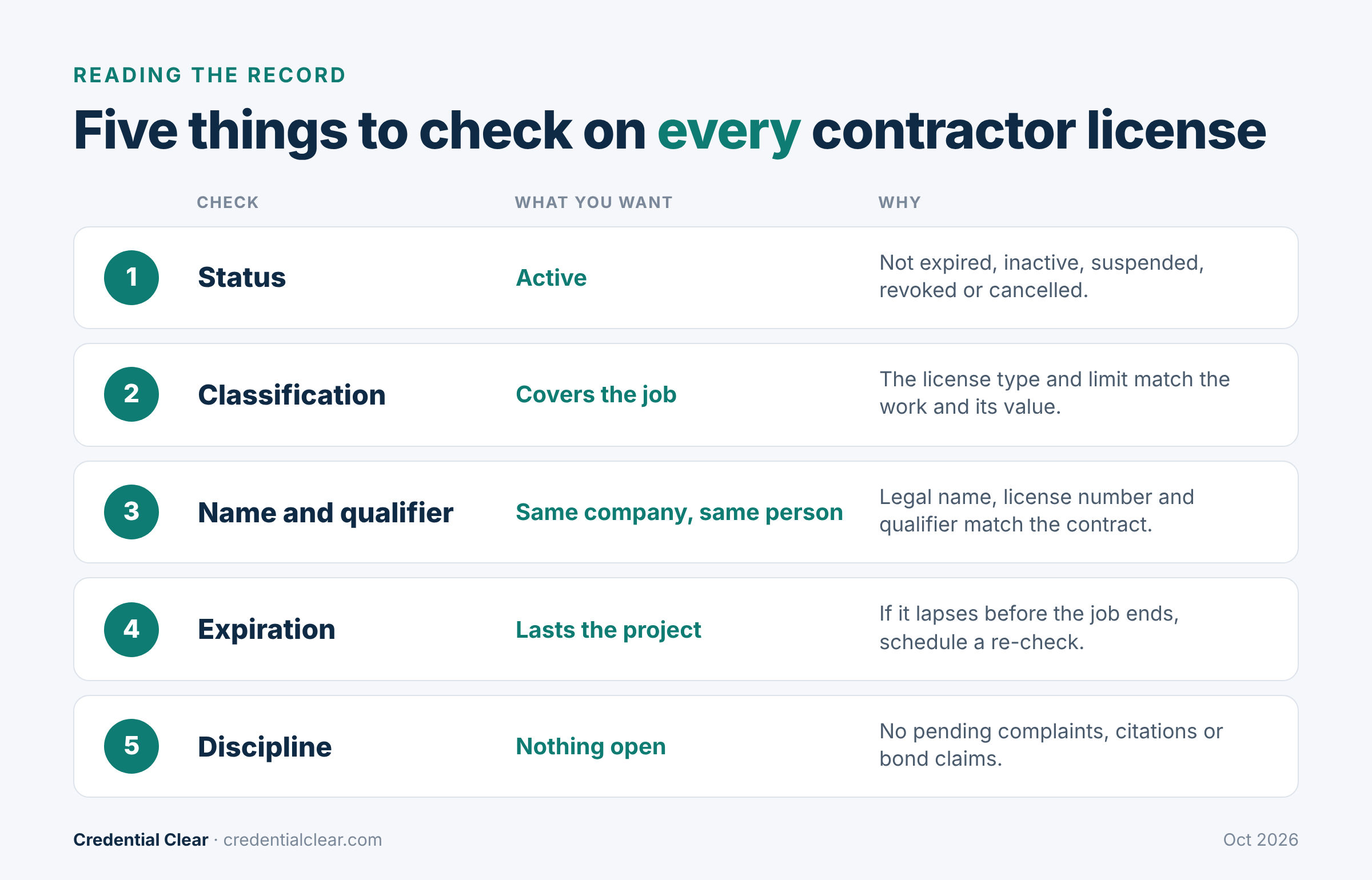
Once you've found the record, read all of it. These five checks take a couple of minutes and catch the problems that "Active" hides.
- Status is active. Anything else (inactive, expired, suspended, revoked, cancelled) means the contractor can't legally do the work. The status section below explains each one.
- Classification covers the job. Most states license by type of work. California, for example, has separate classifications for general building and for each specialty trade. Some states also cap the size of a single project: in North Carolina, a Limited general contractor license tops out at $750,000.
- Name and qualifier match. The legal name and license number should match your contract. Many states tie the license to a qualifier, the licensed individual who passed the exam. If that person leaves, the license can lapse.
- Expiration is after your project ends. If it isn't, put a re-check on the calendar for the renewal date.
- No open discipline. Look for pending complaints, citations, bond claims or recent suspensions. Not every board publishes these, but many do.
Save a dated screenshot or printout of each record. If something goes wrong later, you'll want proof of what you checked and when.
Where to look: contractor licensing boards by state
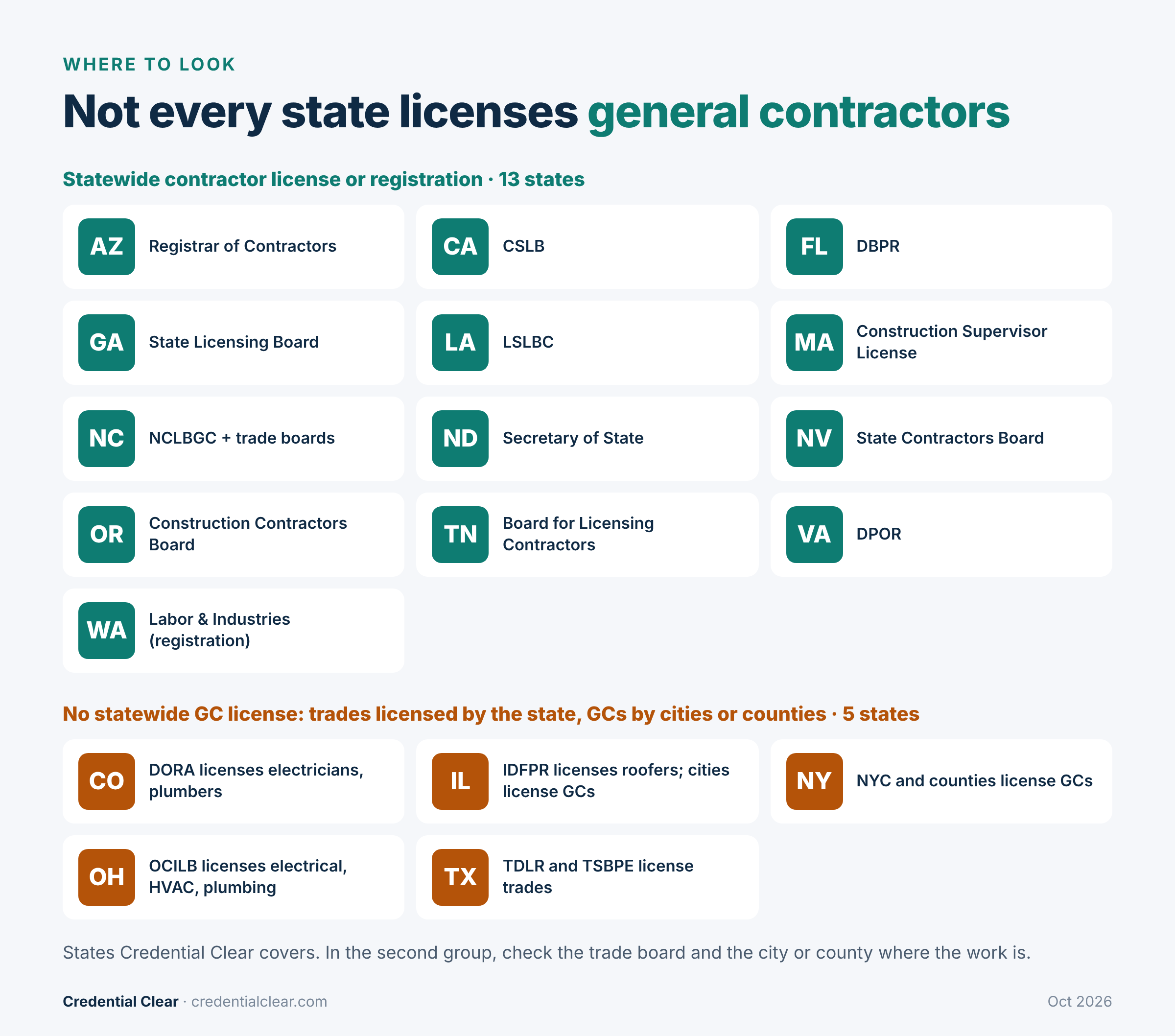
Start with the state where the work is, not where the contractor is based. Eleven of the 16 states below license or register contractors statewide. The other five don't license general contractors at the state level: they license specific trades, and cities or counties license GCs.
| State | Who licenses contractors | Notes | State guide |
|---|---|---|---|
| Arizona | Registrar of Contractors (ROC) | Statewide license; also publishes unlicensed-contractor violations | Arizona |
| California | Contractors State License Board (CSLB) | Statewide license with A, B and C classifications | California |
| Colorado | No statewide GC license; DORA licenses electricians and plumbers | Check the city or county for GCs | Colorado |
| Florida | Department of Business and Professional Regulation (DBPR) | Statewide certified and registered contractors | Florida |
| Georgia | State Licensing Board for Residential and General Contractors | Statewide license; trades have separate boards | Georgia |
| Illinois | No statewide GC license; IDFPR licenses roofers | Chicago and other cities license GCs | Illinois |
| Louisiana | State Licensing Board for Contractors (LSLBC) | Statewide commercial, residential and home improvement licenses | Louisiana |
| Nevada | State Contractors Board (NSCB) | Statewide license with monetary limits | Nevada |
| New York | No statewide GC license | New York City and several counties license GCs and home improvement contractors | New York |
| North Carolina | NCLBGC plus separate trade boards | GC license required at $40,000; trades at any price | North Carolina |
| North Dakota | Secretary of State | License required for jobs over $4,000; classes A to D by job size | North Dakota |
| Ohio | No statewide GC license; OCILB licenses electrical, HVAC, plumbing, hydronics and refrigeration | Cities license GCs | Ohio |
| Oregon | Construction Contractors Board (CCB) | Statewide license; also shows bond and insurance | Oregon |
| Texas | No statewide GC license; TDLR and TSBPE license trades | Electricians, HVAC and plumbers licensed statewide | Texas |
| Virginia | Department of Professional and Occupational Regulation (DPOR) | Class A, B and C contractors | Virginia |
| Washington | Department of Labor & Industries (L&I) | Statewide registration, with bond and insurance | Washington |
In the five states without a statewide GC license, check two places: the state trade board for electrical, plumbing and HVAC work, and the city or county where the job is for the general contractor.
What each license status means
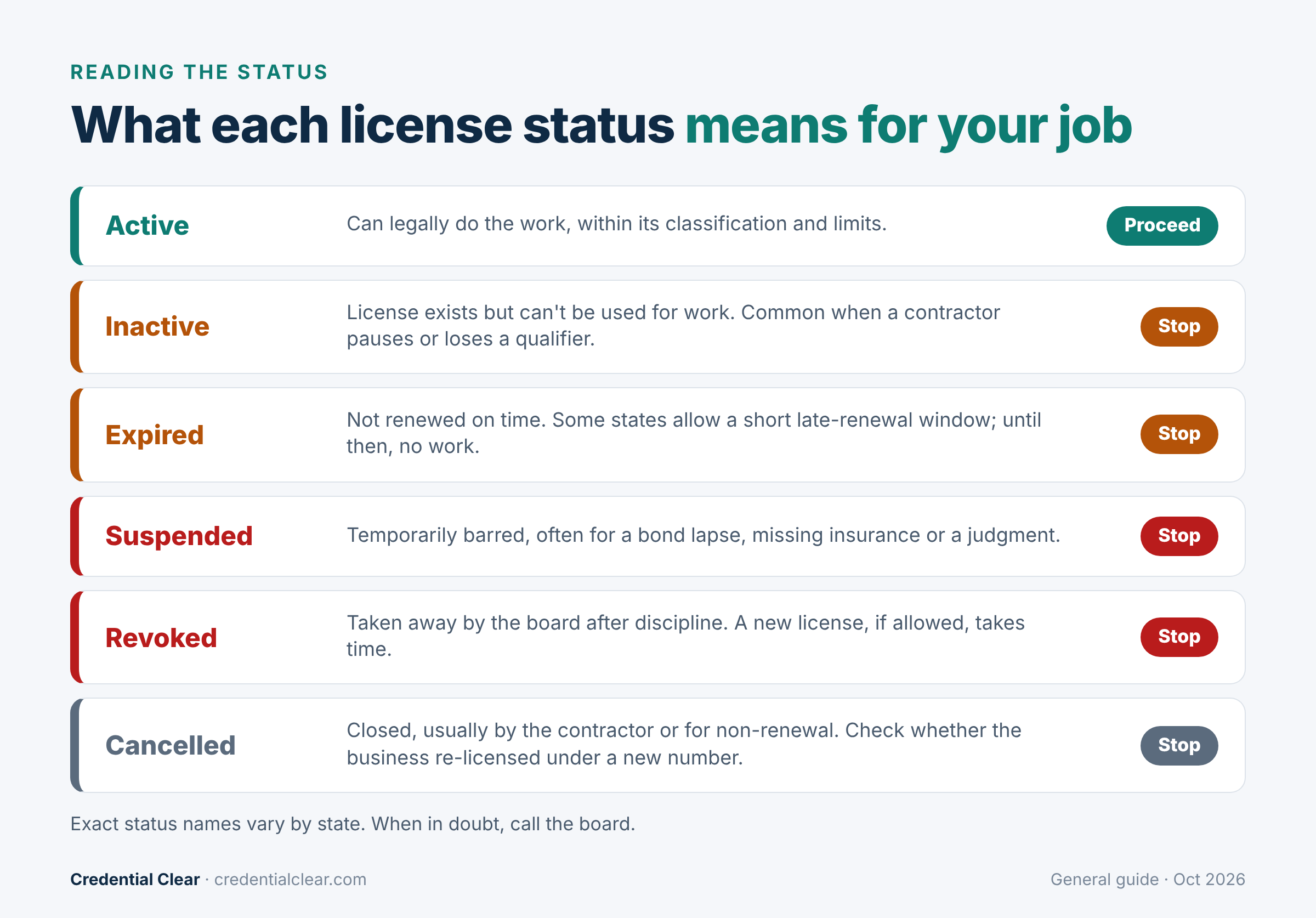
Only one status means go. Status names vary a little by state, but they fall into these groups.
Active: the contractor can legally do the work, within its classification and limits.
Inactive: the license exists but can't be used for contracting. This often happens when a contractor pauses the business or loses its qualifier.
Expired: the license wasn't renewed on time. Some states allow a short late-renewal period, but the contractor can't work until it's renewed.
Suspended: the contractor is temporarily barred, often because a bond lapsed, insurance wasn't on file, or a judgment went unpaid.
Revoked: the board took the license away after disciplinary action. Getting a new one, where allowed, takes time.
Cancelled: the license was closed, usually by the contractor or for non-renewal. Check whether the same owners now operate under a different license number.
If a status is unclear, call the board. It's a five-minute call and boards answer this question all day.
"Licensed and insured" are two different checks
A license lookup tells you about the license. It usually doesn't prove the contractor carries general liability or workers' compensation insurance today. A few states show bond or insurance details on the license record (Oregon and Washington, for example), but most don't.
For insurance, ask the contractor for a certificate of insurance (COI) and confirm it with the insurance agent listed on it. Ask to be named as a certificate holder so you hear about cancellations.
Why one check isn't enough
A license check is a snapshot. Licenses expire, lapse when a qualifier leaves, or get suspended in the middle of a project. A check at onboarding tells you nothing about month six.
The risk grows with the roster. A general contractor with 60 subs across three states, or a property manager with 200 vendors, is tracking hundreds of renewal dates across different boards that each work differently.
Checking a whole roster
Credential Clear searches state licensing boards for you, including several boards at once where a state splits them (five in North Carolina). It cross-references disciplinary records, flags contractors that appear on state unlicensed-violator lists, and keeps monitoring so you're alerted when a license expires or its status changes.
It covers all 18 states in the table above. Start a free trial or request a demo to check your current roster.
Frequently asked questions
Can I look up a contractor's license by name?
Yes. Most state boards let you search by business name, individual name or license number. A name search can return several similar companies, so confirm the license number and address before relying on the result.
How do I find a contractor's license number?
Ask the contractor. Many states require it on bids, contracts or advertising. You can also search the state board by business name and take the number from the record.
What does an inactive contractor license mean?
The license exists but can't be used to do contracting work. The contractor has to reactivate it before taking your job.
Do all states license general contractors?
No. Of the 18 states in this guide, Colorado, Illinois, New York, Ohio and Texas don't license general contractors statewide. They license specific trades, and cities or counties license GCs.
Does a license lookup show if a contractor is insured?
Usually not. A few states show bond or insurance details, but you should ask for a certificate of insurance and confirm it with the insurer.
How often should I re-check a subcontractor's license?
At minimum, before each new contract and before the license's expiration date. For an active roster, monthly checks or automated monitoring catch suspensions that happen between renewals.