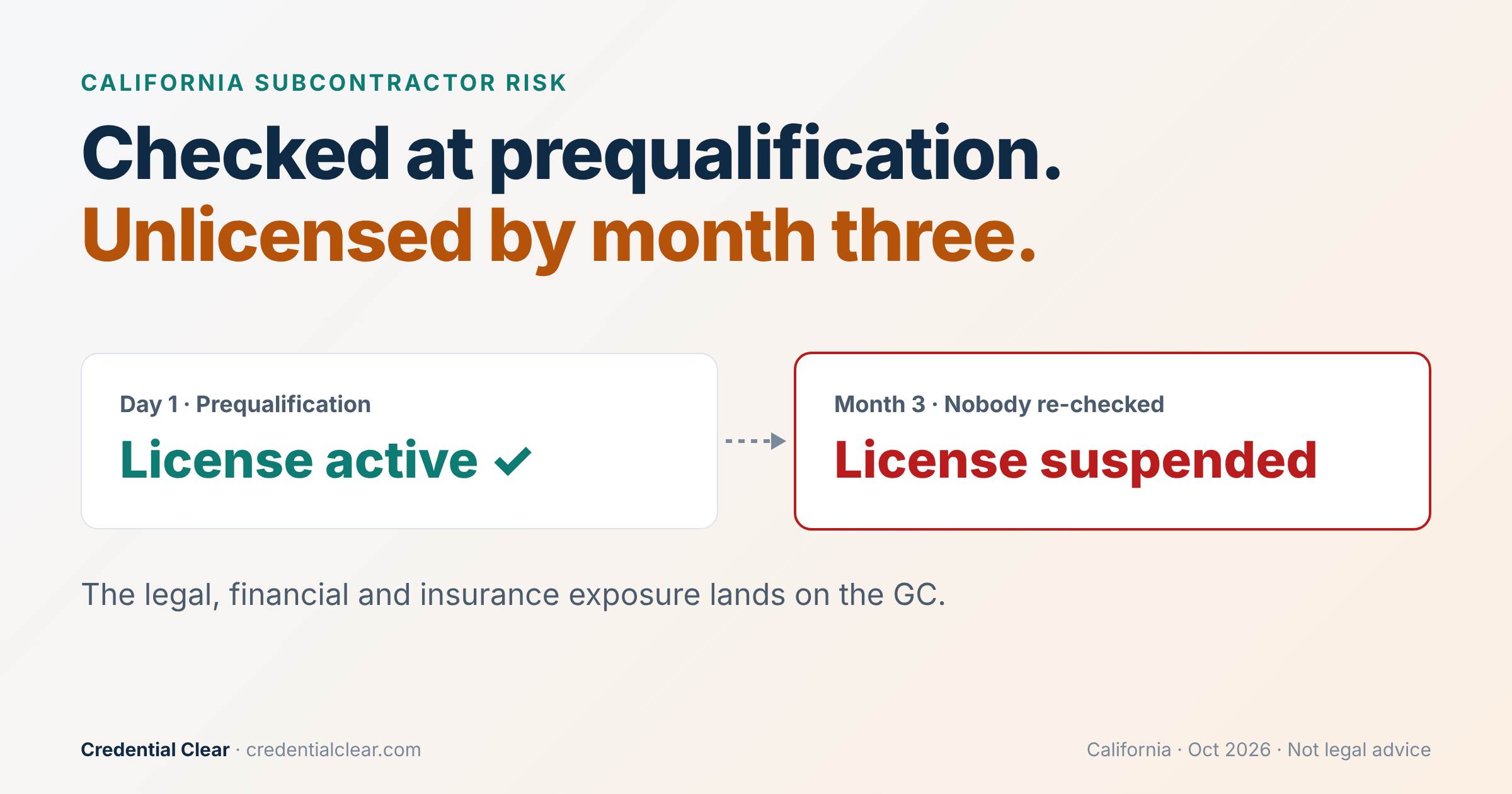
Your prequalification process works. That's not the problem.
Short answer: In California, a subcontractor that passes your prequalification check can lose its license mid-project, most often because its workers' comp policy or bond is cancelled. From that date, the sub is unlicensed. That can expose the general contractor to CSLB discipline, wage and workers' comp claims from the sub's crew, and coverage disputes with its own insurers. The fix is to re-verify licenses during the project, not just before it.
Let's assume you already do this well. You have a prequalification workflow. Every sub fills out the questionnaire, sends a certificate of insurance and a W-9, and someone on your team looks the sub up on the CSLB site. The license was active. The classification fit the scope. The sub was approved and went on your list.
That check was accurate on the day you ran it. The question this article answers is what happens when it stops being accurate, and nobody looks again until the next project.
How a California license goes bad mid-project
Most California licenses don't fail at renewal. They fail in between, because something the license depends on lapses. The CSLB lists the main triggers for suspension (source):
- Workers' comp is cancelled or expires. Under Business and Professions Code § 7125.2, the license is suspended on the date coverage lapses, or the date it was required, whichever comes first (source).
- The contractor's bond is cancelled or reduced by a claim or judgment.
- The qualifier leaves. If the Responsible Managing Officer or Employee who qualifies the license isn't replaced within 90 days, the license is suspended.
- A civil judgment goes unreported or unpaid for 90 days.
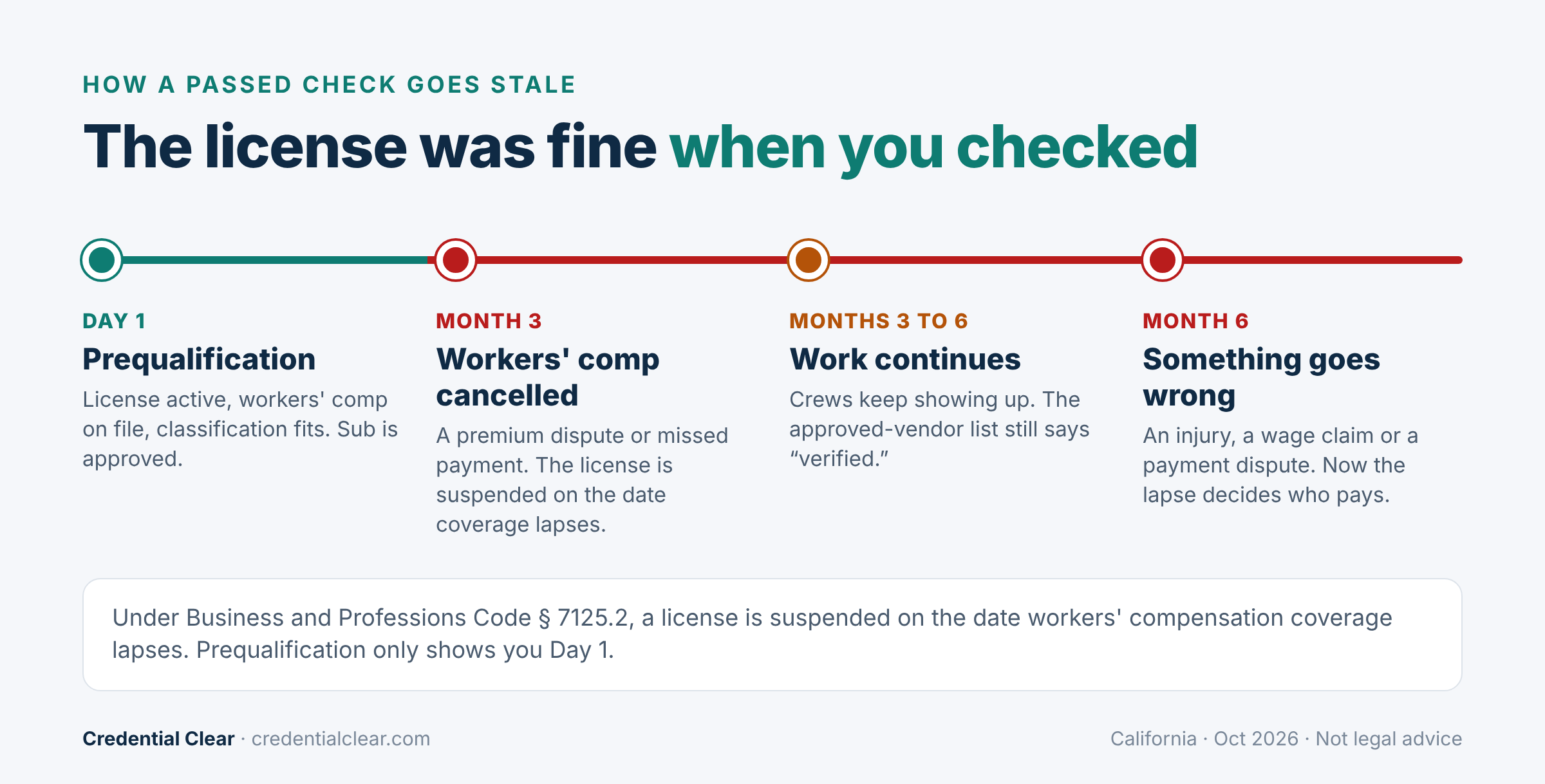
None of these show up in your prequalification file. The certificate of insurance you collected still says the policy runs through next year. The sub may not tell you, and may not even know yet. Crews keep showing up.
This isn't theoretical. In American Building Innovation v. Balfour Beatty Construction (2024), a subcontractor started a school project fully licensed with workers' comp in place. Its insurer cancelled the policy over a premium dispute in January 2018, which suspended the license. The sub kept working. When it later sued the general contractor for payment, the court held it wasn't licensed at all times during the work and couldn't recover. The sub ended up facing more than $1.5 million in the GC's legal fees and is no longer in business (source).
That case went the GC's way. The next sections cover the cases that don't.
One date to watch: California law will require every licensed contractor to carry workers' comp, but that mandate was pushed back to January 1, 2028 (source). Until then, many subs operate on an exemption claiming no employees. A sub on your job with a crew and an exemption on file is a red flag on its own.
The legal risks
Your own license
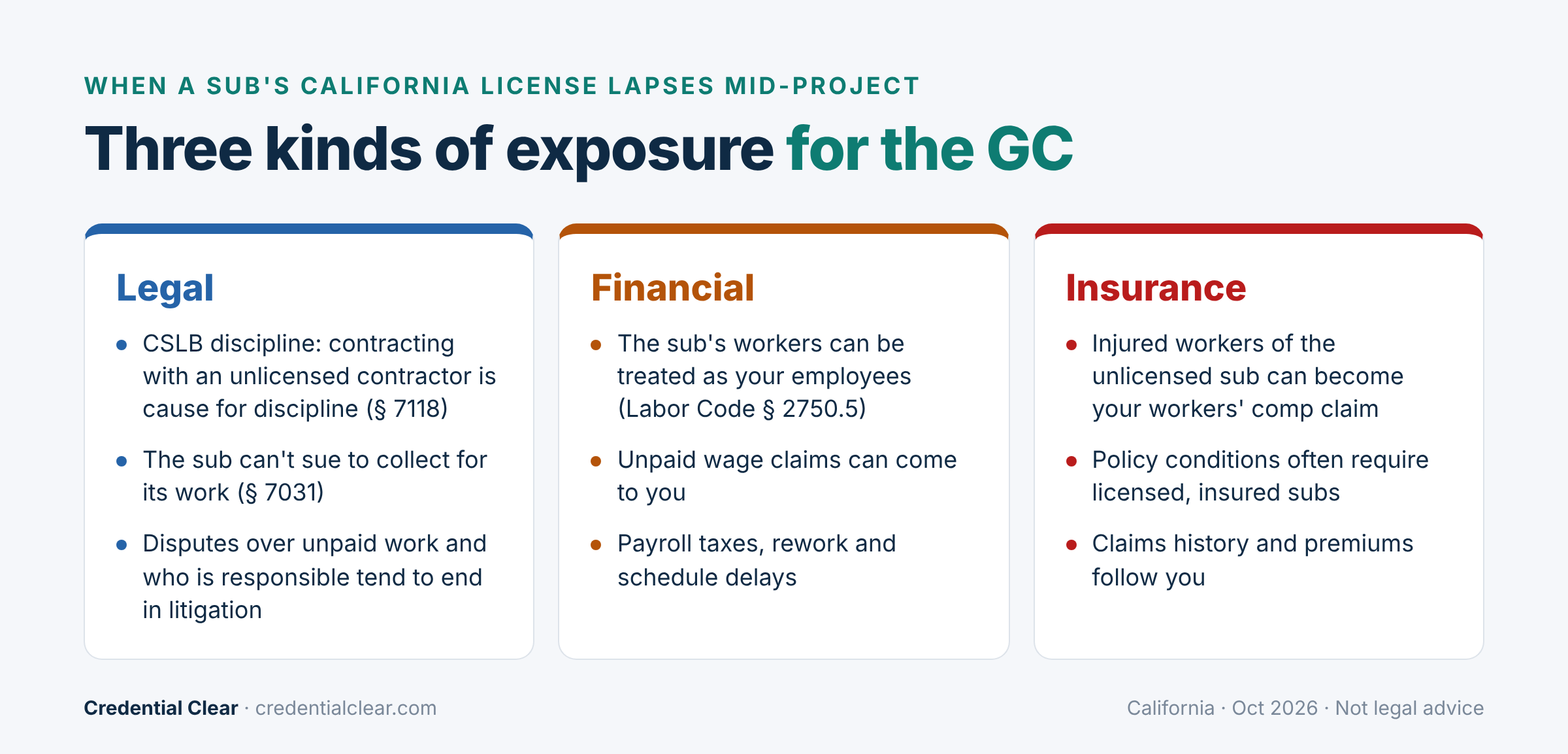
Under Business and Professions Code § 7118, "entering into a contract with a contractor while such contractor is not licensed" is cause for disciplinary action against your license. The CSLB does bring these charges, alongside other violations, in its accusations against licensed contractors (example).
A subcontract signed while the sub was licensed is the easier case to defend. The exposure grows with every new agreement signed after the lapse: change orders, a second phase, the next project with the same "approved" sub. Your prequalification file says yes. The CSLB record says no.
The payment fight
Under § 7031, a contractor can't sue to collect for its work unless it was "duly licensed at all times during the performance." The same section lets whoever paid an unlicensed contractor sue to recover what they paid. California courts have applied this even when the work was good.
On paper that favors the GC. In practice it turns an ordinary payment dispute into litigation over license dates, retroactive reinstatement and who knew what when. American Building Innovation took years to resolve. Your project manager, your counsel and your schedule all pay for that fight, even when you win it.
The financial risks
The sub's crew can become your employees
This is the exposure most GCs don't see coming. Labor Code § 2750.5 says a person doing work that requires a license must hold that license to count as an independent contractor. California courts have read this to make a general contractor the employer of the workers employed by its unlicensed subcontractor.
In Sanders Construction Co. v. Cerda (2009), a drywall sub's license expired during a hotel project. When the sub stopped paying its crew, the workers sued the general contractor for their wages, and the court let them (source). The GC never set their hours or signed their checks.
The same reasoning can reach beyond wages to payroll tax withholding and unemployment insurance contributions.
Rework, delay and replacement
Work performed while a sub was unlicensed can draw questions from inspectors, owners and lenders. Replacing a sub mid-project means a new bid, mobilization and schedule recovery, usually at a premium.
The insurance risks
- Workers' comp claims land on your policy. If the sub's workers are treated as your employees, an injured worker on the unlicensed sub's crew can become a claim against your workers' comp coverage. That affects your claims history and your future premiums.
- Policy conditions may not be met. Many commercial general liability policies and subcontract insurance requirements assume subs are licensed and insured. A claim tied to an unlicensed sub's work can lead to a coverage dispute. Ask your broker exactly what your policy requires of subs, and whether you can show you met it during the project, not just before.
- The sub's own coverage may be gone. The most common reason for a mid-project suspension is a cancelled workers' comp policy. The coverage you relied on at prequalification may be the thing that lapsed.
Closing the gap after prequalification
You don't need a new process. You need the one you have to run more than once. Add these to the workflow you already use:
- Re-check at every payment. Make an active CSLB license, with workers' comp or a valid exemption on the record, a condition of each progress payment. Pay applications are a checkpoint you already have.
- Re-check before every change order and new subcontract. Those are the agreements § 7118 is most likely to reach.
- Read the workers' comp line, not just the status. The CSLB record shows the sub's workers' comp policy or exemption. A crew on site and an exemption on file don't go together.
- Put notice duties in the subcontract. Require the sub to tell you within a set number of days of any suspension, bond cancellation, insurance cancellation or qualifier change. Add an indemnity for losses caused by a licensing lapse. Have your counsel draft the language.
- Keep dated records. Save each check with the date. If a dispute comes, your best defense is showing you checked during the project.
- Automate it once the roster gets big. Checking 10 subs every two weeks is manageable. Checking 80 across several states is how checks get skipped.
How CredentialClear fits
CredentialClear runs the check after prequalification, so you don't have to remember to. It watches your subs' licenses on the state boards and alerts you when a license expires or its status changes. It also flags contractors on state unlicensed-violator lists.
It covers multiple states. Start a free trial and load the subs on your current projects. You'll see where every license stands today, not on the day you approved it.
This article is general information, not legal advice. Talk to a California construction attorney about your contracts and specific situation.
Frequently asked questions
What happens if a subcontractor's license expires during a project in California?
From the date of the lapse, the sub is unlicensed for California purposes. It generally can't sue to collect for its work, and the GC may face CSLB discipline for contracting with it, plus wage and workers' comp exposure for the sub's crew.
Is a general contractor liable for an unlicensed subcontractor's workers in California?
It can be. Under Labor Code § 2750.5, courts have treated the workers of an unlicensed subcontractor as employees of the general contractor, including for unpaid wage claims.
Why would a California contractor license be suspended mid-project?
The most common reasons are a cancelled workers' comp policy, a cancelled or reduced contractor's bond, a qualifier who leaves and isn't replaced within 90 days, and unpaid judgments.
Can an unlicensed subcontractor get paid in California?
Generally, a contractor that wasn't licensed at all times during the work can't sue to collect under Business and Professions Code § 7031. Whoever paid it may be able to recover what they paid.
How often should a GC re-check subcontractor licenses?
At minimum, before each progress payment, change order and new subcontract. Continuous monitoring catches suspensions between those points.
Do all California contractors have to carry workers' comp?
Not yet. Contractors with no employees can file an exemption. A requirement for all licensed contractors to carry workers' comp takes effect January 1, 2028.
Sources
- CSLB: Major reasons for suspension
- Business and Professions Code § 7125.2: suspension on workers' comp lapse
- CSLB accusation citing § 7118
- Daily Journal: American Building Innovation v. Balfour Beatty (2024)
- Allen Matkins: Sanders Construction v. Cerda and Labor Code § 2750.5
- Business Insurance: workers' comp mandate delayed to 2028 (SB 1455)